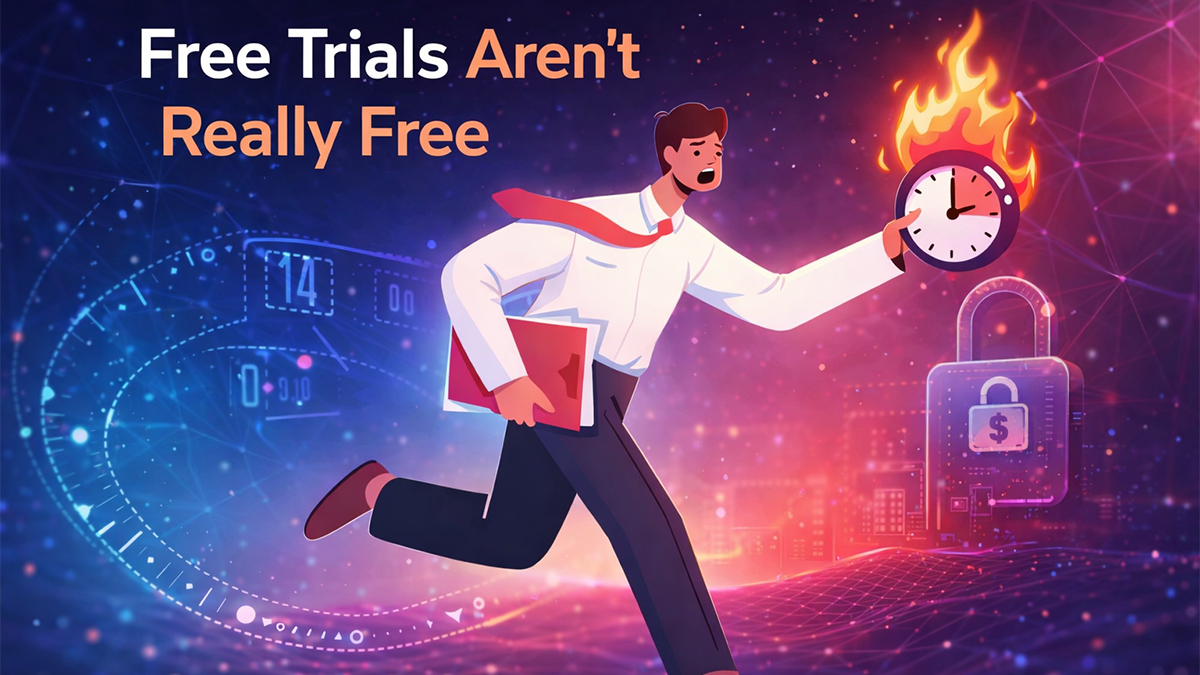
The Hidden Cost of “Free Trials” in SaaS
What
Startups and Remote Teams Should Know Before Signing Up
In today’s software landscape, “Free
Trial” has become one of the most common phrases in SaaS marketing. Almost
every productivity tool, CRM, time tracker, analytics dashboard, or project
management platform offers a 7-day, 14-day, or 30-day trial.
At first glance, this sounds fair —
even generous.
But for startups, freelancers, and
small teams operating on tight budgets, free trials often come with hidden
costs that go beyond money. These costs show up in pressure, disruption,
confusion, and sometimes unexpected financial strain.
Free trials are not inherently bad.
Many reputable companies use them responsibly. However, understanding the
structural incentives behind free trials helps teams make smarter decisions.
Let’s break down what’s really
happening beneath the surface.
Why
SaaS Companies Use Free Trials
From a business perspective, free
trials make sense.
SaaS companies operate on metrics
such as:
- Customer Acquisition Cost (CAC)
- Lifetime Value (LTV)
- Conversion Rate
- Churn Rate
A free trial lowers the barrier to
entry. It allows potential customers to experience the product before
committing. In theory, this builds trust and increases conversion.
However, in practice, free trials
are often designed around urgency and conversion optimization — not long-term
user comfort.
The primary goal is simple:
Get users in quickly, convert them before the trial ends, and move them into
recurring billing.
That’s where the hidden costs begin.
Hidden
Cost #1: Psychological Pressure
Free trials frequently come with
countdown timers:
“13 days left.”
“Upgrade before access expires.”
“Don’t lose your data.”
This creates subtle but powerful
psychological pressure.
Research in behavioral economics
shows that humans respond strongly to:
- Loss aversion
- Scarcity triggers
- Urgency cues
When a trial period is ticking down,
users are pushed into making faster decisions than they otherwise would.
Instead of asking, “Is this tool truly right for our workflow?” teams start
asking, “Should we upgrade now so we don’t lose access?”
That shift changes decision quality.
Startups especially may feel rushed
into committing to tools they haven’t fully evaluated — simply to avoid disruption.
Hidden
Cost #2: The Credit Card Trap
Many SaaS platforms require a credit
card before starting the trial. While this seems harmless, it alters user
psychology dramatically.
When payment details are entered
upfront:
- Automatic billing becomes likely
- Forgotten cancellations become expensive
- Trial expiration becomes a financial risk
Even if cancellation is easy, the
user now carries mental overhead.
For small teams juggling multiple
tools, this can create budget surprises at the end of the month.
What began as “just testing a tool”
turns into an unexpected recurring subscription.
Hidden
Cost #3: Workflow Disruption
Perhaps the most overlooked cost of
free trials is operational.
Imagine this scenario:
A startup adopts a new project
management tool.
The team moves tasks into it.
Files are uploaded.
Workflows are structured.
Then the trial ends.
If the company decides not to
upgrade, they must:
- Export data
- Migrate tasks
- Rebuild systems elsewhere
- Retrain the team
This disruption has real productivity
costs.
Even if no money was spent, time
was.
In small teams, time is often more
valuable than subscription fees.
Hidden
Cost #4: Feature Fragmentation
Many free trials grant access to all
premium features. That’s intentional.
During the trial, users experience
the “best version” of the product. Once the trial ends, the free version (if
one exists) may be significantly limited.
Features that felt essential during
onboarding suddenly disappear unless you upgrade.
This creates a dependency loop:
- Experience full capability
- Build workflow around premium features
- Lose access
- Upgrade to maintain continuity
From a growth perspective, this is
effective.
From a trust perspective, it can feel manipulative.
Hidden
Cost #5: Scaling Shock
Pricing pages are often designed
around per-user billing.
A tool that costs $12 per user per
month seems affordable — until the team grows.
For example:
5 team members ? $60/month
15 team members ? $180/month
30 team members ? $360/month
What started as manageable becomes a
meaningful operational expense.
Free trials rarely show this
long-term scaling impact clearly during onboarding.
For startups operating with limited
runway, this kind of scaling surprise can be stressful.
Hidden
Cost #6: Decision Fatigue
Modern teams use multiple SaaS
tools:
- Communication
- Project management
- Time tracking
- CRM
- Invoicing
- Documentation
Each tool offering a trial creates:
- Evaluation cycles
- Feature comparison
- Migration testing
- Upgrade decisions
When trials expire at different
times, teams constantly make micro-decisions.
This creates cognitive load.
Instead of focusing on building
product or serving clients, founders end up managing subscription decisions.
The
Economic Reality Behind Free Trials
Free trials exist because they work
— for vendors.
If a SaaS company knows:
- 20% of trial users convert
- Average customer lifetime value is high
- Retention is strong
Then even a short trial funnel is
profitable.
This is not unethical by default. It
is simply business strategy.
However, incentives matter.
If conversion optimization becomes
the primary goal, user comfort may become secondary.
That’s when friction replaces
transparency.
Free
Trial vs Freemium vs Free Forever
It’s important to distinguish
between models.
Free
Trial
Temporary access to premium
features, then pay or lose access.
Freemium
Limited version available
indefinitely, premium upgrades optional.
Free
Forever (Core Plan)

A stable, functional core version
remains permanently free, without expiration pressure.
The difference is structural.
Free trials are time-driven.
Freemium and free-forever models are trust-driven.
In a trust-driven model, users grow
organically. Upgrades happen when scale demands it — not when a countdown
forces it.
Why
This Matters for Startups and Remote Teams
Early-stage teams operate
differently from enterprises.
They value:
- Predictability
- Stability
- Low financial risk
- Flexible scaling
A time-limited model can disrupt
planning.
Remote teams especially depend on
workflow consistency. If tools change frequently, collaboration suffers.
When systems are stable and
accessible, teams can focus on outcomes instead of subscriptions.
Are
Free Trials Always Bad?
No.
Free trials can be:
- Transparent
- Clearly structured
- Optional (without credit card)
- Supported by fair cancellation policies
The issue is not the model itself.
The issue is how aggressively it is implemented.
If urgency replaces clarity, trust
erodes.
If feature baiting replaces value
demonstration, frustration increases.
What
to Look for Before Starting a Free Trial
Before signing up for any SaaS
trial, ask:
- Is a credit card required?
- What happens when the trial ends?
- Will my data be accessible?
- Is there a permanent free plan?
- How does pricing scale with team growth?
These questions reduce hidden costs.
They shift control back to the user.
A
Shift Toward Trust-Based Software
As the SaaS industry matures, many
users are becoming more aware of pricing psychology.
There is a growing demand for:
- Transparent billing
- Predictable access
- Ethical growth models
- Flexible scaling
In the long run, trust often
outperforms urgency.
Software that respects user timing
builds stronger retention.
Teams remember tools that supported
them early — without pressure.
Final
Thoughts
“Free Trial” is one of the most
powerful marketing tools in SaaS.
But free does not always mean
frictionless.
Hidden costs appear in:
- Psychological pressure
- Workflow disruption
- Budget surprises
- Scaling shock
- Decision fatigue
For startups, freelancers, and remote
teams, understanding these hidden costs allows smarter software decisions.
The goal is not to avoid free trials
entirely.
The goal is to approach them
consciously.
Because productivity tools should
reduce stress — not create it.
And the best long-term software
relationships are built on clarity, not countdown timers.