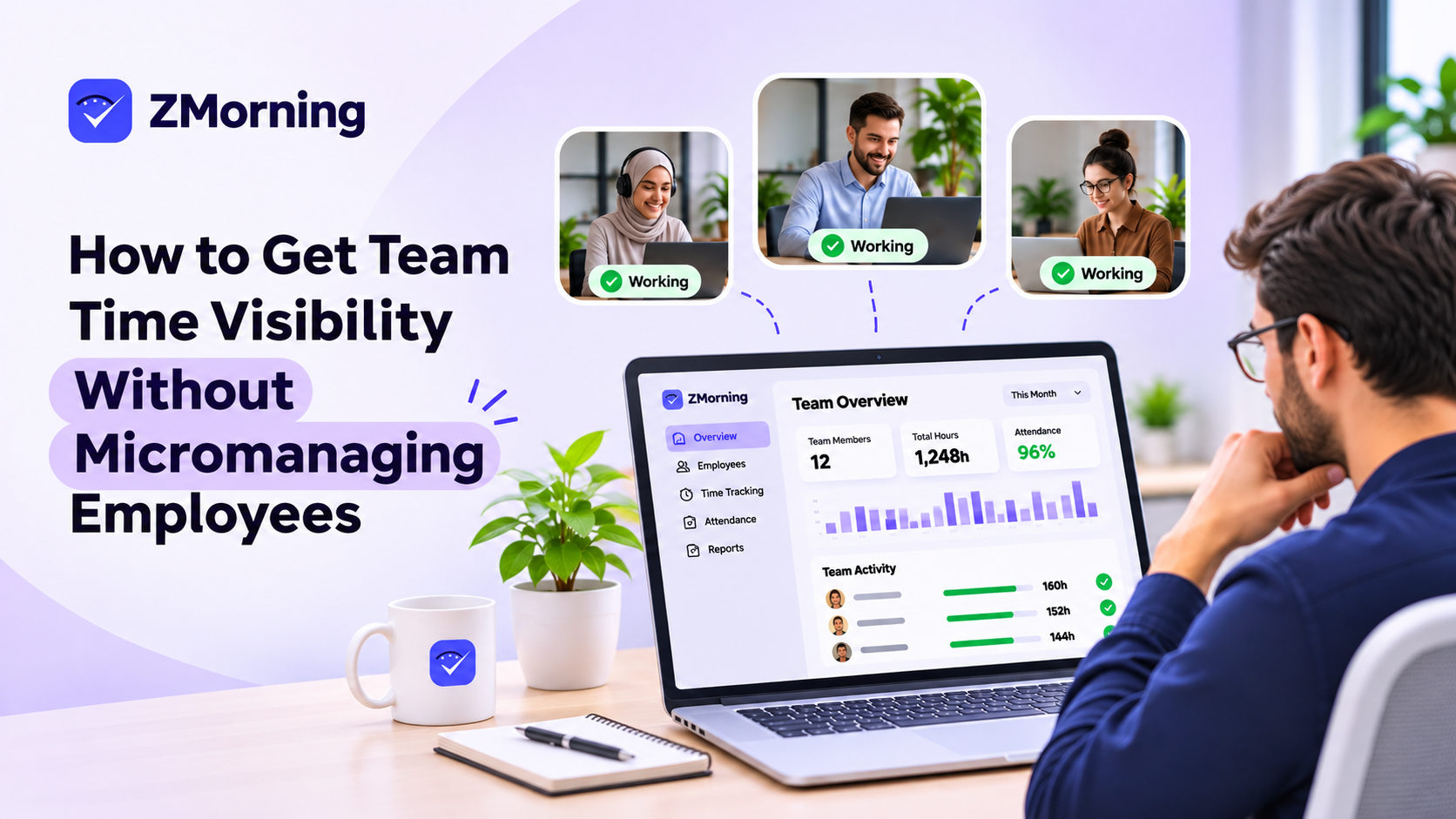
Managing a team effectively requires more than knowing who is working and how many hours they spend on their tasks. Managers need a clear understanding of how time is being used, where workloads are increasing, and whether projects are progressing as expected. However, achieving this level of visibility can become challenging when employees feel constantly monitored or pressured to justify every minute of their working day.
The real challenge is finding the right balance between employee time tracking and workplace trust.
Micromanagement often creates unnecessary pressure, reduces employee independence, and can negatively affect workplace morale. On the other hand, having no reliable insight into working hours, attendance, or workload distribution makes it difficult for managers to plan resources and maintain accountability.
The solution is to build a transparent time management system that provides managers with meaningful information while allowing employees to work independently.
In this guide, we will explore how businesses can improve team time visibility, maintain employee trust, and manage productivity without creating a culture of constant supervision.
What Is Team Time Visibility?
Team time visibility is the ability to understand how employees use their working hours, manage their responsibilities, and contribute to business activities.
It gives managers access to relevant information about team availability, attendance, working hours, and workload distribution without requiring them to constantly ask employees for updates.
Effective team time visibility helps businesses answer important questions:
Are employees working according to their scheduled hours?
How much time is being spent on different responsibilities?
Are certain team members consistently overloaded?
Are projects receiving the time and attention they require?
Where are scheduling conflicts or productivity challenges occurring?
However, visibility does not mean watching employees throughout the day. It means collecting useful information that supports better decisions.
A well-designed employee time management process focuses on work patterns, outcomes, and operational efficiency rather than unnecessary supervision.
Why Micromanaging Employees Is Not an Effective Management Strategy
Micromanagement usually develops when managers feel they lack control or reliable information about their team's activities.
Without clear processes or accurate records, they may start requesting frequent updates, checking individual activities repeatedly, or asking employees to explain how they spend their time.
Although these actions may appear to improve accountability, they often create additional problems.
1. It Reduces Employee Independence
Employees need enough freedom to organize their responsibilities and complete tasks using their own judgment.
When managers constantly check every activity, employees may become less confident in making decisions independently.
Giving employees clear expectations and allowing them to manage their work encourages ownership and responsibility.
2. It Creates Unnecessary Communication
Repeated requests for status updates interrupt normal workflows.
For example, if a manager needs to ask every employee individually about attendance, working hours, and task progress, valuable time is spent collecting information instead of managing important business activities.
Centralized reporting can reduce these unnecessary interruptions.
3. It Can Damage Workplace Trust
Employees may interpret excessive monitoring as a sign that management does not trust them.
Over time, this can affect motivation, engagement, and workplace relationships.
Transparent policies help employees understand what information is collected, why it is needed, and how it supports the organization.
4. It Shifts Attention Away From Results
Being busy does not necessarily mean being productive.
An employee may spend many hours at work without making meaningful progress, while another may complete important responsibilities efficiently.
Managers should consider working hours alongside responsibilities, deliverables, and business outcomes.
The goal should be better performance, not simply more monitoring.
8 Practical Ways to Improve Team Time Visibility Without Micromanagement
Creating a transparent and efficient work environment requires the right processes, expectations, and technology.
Here are eight practical ways businesses can achieve better team time visibility while maintaining employee independence.
1. Establish Clear Working Hours and Attendance Expectations
The first step is to establish clear expectations about working schedules and attendance.
Employees should understand:
Their expected working hours.
When they should start and finish work.
How breaks and overtime are handled.
How to report absences or schedule changes.
What to do when unexpected circumstances affect attendance.
When these expectations are communicated clearly, managers do not need to repeatedly remind employees about basic responsibilities.
A consistent attendance process also makes it easier to identify scheduling issues and maintain accurate working-hour records.
2. Use Employee Time Tracking Software
Manually collecting working-hour information becomes increasingly difficult as a business grows.
Employee time tracking software helps centralize working-hour records and makes relevant information easier to access.
Instead of relying on individual messages, spreadsheets, or memory, managers can use a structured system to review time-related information.
Depending on the software, useful capabilities may include:
Employee clock-in and clock-out records.
Daily and weekly working-hour summaries.
Attendance history.
Overtime information.
Employee timesheets.
Time reports for management.
The purpose of using time tracking software should not be to monitor every employee action. It should be to reduce administrative work, improve record accuracy, and give managers a reliable overview of team availability.
3. Focus on Outcomes Instead of Constant Activity Monitoring
One of the most important changes managers can make is shifting their attention from employee activity to measurable outcomes.
Rather than asking employees what they are doing every hour, establish clear responsibilities and realistic deadlines.
For example, instead of requesting frequent updates about a task, managers can agree on:
This approach gives employees more control over their work while ensuring managers understand whether important responsibilities are progressing.
Time tracking provides additional context, but actual performance should be evaluated using relevant results and responsibilities.
4. Use Reports to Identify Workload Imbalances
Time reports can help managers understand how work is distributed across a team.
For example, if one employee regularly records more working hours than others, it may indicate an uneven workload, insufficient resources, or scheduling problems.
Similarly, repeated overtime across a department may suggest that business processes need improvement.
Managers can use these insights to:
Redistribute responsibilities.
Identify employees who may need additional support.
Improve shift planning.
Recognize recurring workload problems.
Make better staffing decisions.
Importantly, longer working hours should not automatically be treated as better performance.
The objective is to create a sustainable workload where employees can complete their responsibilities without unnecessary pressure.
5. Give Employees Access to Their Own Time Records
Transparency should work in both directions.
Employees should be able to understand their own working-hour records and review relevant attendance information.
Providing access to personal time records can help employees:
Verify recorded working hours.
Identify missing or incorrect entries.
Understand their attendance history.
Review overtime information.
Take greater responsibility for their schedules.
When employees can see the same relevant information that managers use, time tracking becomes a shared process rather than a one-sided monitoring activity.
This also helps reduce disagreements caused by incomplete or inaccurate records.
6. Automate Routine Time Management Tasks
Many management activities do not require personal intervention.
For example, collecting attendance records, preparing working-hour summaries, and organizing timesheets can consume considerable administrative time when handled manually.
Automation can reduce these repetitive responsibilities.
Businesses should consider tools that support:
Automatic calculation of recorded working hours.
Centralized attendance records.
Scheduled reports.
Notifications for relevant attendance events.
Easier timesheet management.
Automation allows managers to spend less time collecting information and more time addressing important operational decisions.
However, automated alerts should be relevant and limited. Too many notifications can create the same unnecessary pressure that businesses are trying to avoid.
7. Create a Culture of Transparency and Accountability
Technology alone cannot create a healthy management environment.
Employees need to understand how time tracking works and how the information will be used.
Before introducing a new system, communicate its purpose clearly.
Explain which information is collected, who can access it, how records are reviewed, and how employees can raise concerns about incorrect information.
Businesses should also establish consistent policies for all team members.
When expectations are clear and applied fairly, employees are more likely to accept time management processes.
A transparent workplace encourages accountability without making employees feel that every minute is being questioned.
8. Review Team Performance Regularly, Not Constantly
Managers need regular opportunities to understand team performance, but continuous checking is rarely necessary.
A weekly or monthly review can provide enough information for many management decisions.
During these reviews, managers can consider:
Attendance patterns.
Total working hours.
Overtime trends.
Workload distribution.
Project progress.
Employee feedback.
Operational challenges.
The frequency should depend on the business, the nature of the work, and the level of responsibility involved.
Regular reviews help managers identify problems early without interrupting employees throughout the working day.
What Should Managers Actually Monitor?
Not every available metric provides meaningful information.
Collecting too much data can make management more complicated rather than improving visibility.
Businesses should prioritize information that directly supports scheduling, resource planning, attendance management, and operational decisions.
The following table highlights useful areas to monitor.
| Area | What Managers Should Review | Why It Matters |
|---|
| Attendance | Clock-in, clock-out, absences | Understand team availability |
| Working Hours | Daily and weekly hours | Maintain accurate time records |
| Overtime | Additional working hours | Identify excessive workloads |
| Timesheets | Recorded and submitted hours | Improve administrative accuracy |
| Workload | Distribution of responsibilities | Prevent employee overload |
| Project Progress | Milestones and deadlines | Identify potential delays |
The important distinction is between collecting information and using it effectively.
Managers should avoid treating every metric as a performance measurement. Time records provide operational context, but they do not independently explain employee productivity or the quality of work.
How to Choose the Right Employee Time Tracking Software
Choosing the right employee time tracking software can make a significant difference in how businesses manage their teams.
A suitable solution should provide useful visibility without introducing unnecessary complexity.
Before selecting a platform, consider the following features.
Accurate Time and Attendance Tracking
The system should make it easy to record employee working hours and review attendance information.
Reliable records reduce confusion and help managers make informed scheduling decisions.
Centralized Employee Management
Managers should be able to access relevant employee information from one organized location.
Centralized management reduces the need to switch between multiple tools and manually combine information.
Clear Reports and Summaries
Reports should present important information in a way that is easy to understand.
Daily, weekly, and monthly summaries can help managers identify patterns without reviewing every individual record.
Flexible Access and Permissions
Not every employee needs access to the same information.
The software should support appropriate permissions so employees can review their own records while managers can access the information required for their responsibilities.
Easy-to-Use Interface
A complicated system can create additional administrative work.
Choose software that employees and managers can use without extensive training.
Data Security and Privacy
Employee time records contain sensitive workplace information.
Businesses should evaluate access controls, data protection practices, and applicable privacy requirements before adopting any employee monitoring or time tracking solution.
The right software should make time management more transparent, not make employees feel unnecessarily watched.
How ZMorning Helps Businesses Improve Team Time Visibility
Managing employee schedules, attendance, and working hours becomes more challenging as teams grow.
ZMorning helps businesses organize employee management and time-related information in a centralized web application.
Instead of depending entirely on manual updates and scattered records, businesses can use a more structured approach to managing their workforce.
With relevant employee management and time tracking capabilities, ZMorning can support managers in areas such as:
Employee Management: Keep employee information organized in one place.
Time and Attendance Management: Maintain visibility into employee working hours and attendance records.
Working-Hour Records: Make time-related information easier to review.
Reports and Insights: Use available records to understand team activity and support better decisions.
Administrative Efficiency: Reduce repetitive manual work associated with employee management.
By organizing important workforce information, businesses can spend less time chasing updates and more time supporting their teams.
The objective is not to monitor employees constantly. It is to give managers the information they need to manage responsibilities fairly while allowing employees to focus on their work.
Common Mistakes to Avoid When Improving Team Time Visibility
Even with the right software, poor management practices can undermine the benefits of time tracking.
Avoid these common mistakes:
1. Treating every working minute as a productivity indicator
Working hours provide useful information, but they do not automatically measure the quality or value of someone's work.
2. Introducing tracking without explaining its purpose
Employees should understand why the business collects time-related information and how it will be used.
3. Comparing employees using working hours alone
Different roles and responsibilities require different amounts of time. Fair evaluations should consider job requirements and actual results.
4. Sending excessive notifications
Frequent alerts can interrupt employees and create unnecessary stress. Notifications should focus on meaningful events that require attention.
5. Ignoring employee feedback
Employees may identify problems with schedules, time records, or management processes that are not immediately visible in reports.
Listening to their feedback helps businesses improve their systems.
6. Collecting more information than necessary
Managers should focus on relevant operational data rather than collecting information simply because the technology makes it possible.
Frequently Asked Questions (FAQs)
1. How can managers track employee working hours without micromanaging?
Managers can use employee time tracking software to maintain accurate attendance and working-hour records. By setting clear expectations and reviewing reports periodically, they can understand team availability without constantly requesting individual updates.
2. What is the difference between employee time tracking and employee monitoring?
Employee time tracking focuses on recording working hours, attendance, and time-related activities. Employee monitoring can involve broader observation of employee activities. Businesses should choose transparent and proportionate practices that meet their operational needs while respecting employee privacy.
3. Does employee time tracking improve productivity?
Time tracking can support productivity by helping businesses identify scheduling problems, excessive overtime, and workload imbalances. However, recorded working hours alone do not measure productivity. Results, responsibilities, and work quality should also be considered.
4. How often should managers review employee time reports?
For many businesses, weekly reviews are useful for identifying attendance patterns and workload concerns, while monthly reviews can help with broader planning. The appropriate frequency depends on team size, operational requirements, and the type of work.
5. Can small businesses benefit from team time visibility?
Yes. Small businesses can benefit significantly from organized attendance and working-hour records. Even a small team needs clear schedules, reliable time records, and a consistent approach to managing employee responsibilities.
6. What features should employee time tracking software include?
Useful features include employee attendance records, clock-in and clock-out tracking, working-hour summaries, timesheets, reporting, and appropriate access permissions. The best solution depends on the organization's size and management requirements.
Final Thoughts
Getting better team time visibility does not require managers to supervise every employee throughout the day.
Effective workforce management comes from combining clear expectations, reliable time records, transparent communication, and trust.
When businesses use employee time tracking software responsibly, managers gain a clearer understanding of attendance, working hours, and workload distribution. Employees, meanwhile, receive the independence they need to manage their responsibilities.
The goal is simple: Know how your team works without making your team feel constantly watched.
With a structured time management process and the right tools, businesses can improve accountability, make smarter decisions, and build a more productive workplace.
Explore how ZMorning can help your business organize employee management and build a more transparent approach to workforce management.